

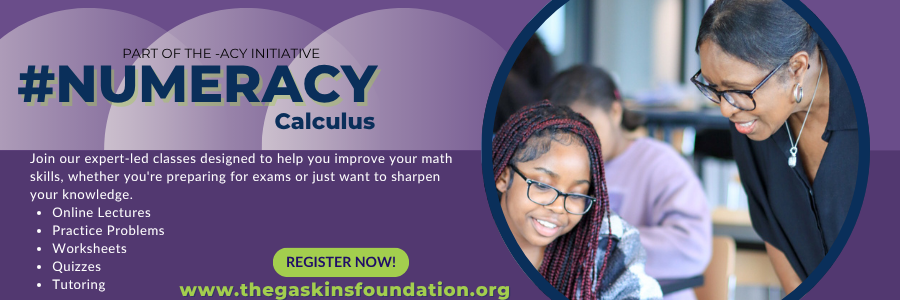
📘 Calculus I Course Overview
🎯 Course Description
Calculus I introduces students to the mathematics of change and accumulation, providing the foundation for advanced study in science, engineering, technology, and economics.
In this course, students will explore how quantities change, how to model real-world systems, and how to analyze those systems using powerful mathematical tools. Beginning with limits and continuity, the course builds toward derivatives, applications of derivatives, and integrals—culminating in the Fundamental Theorem of Calculus.
🚀 What You Will Learn
By the end of this course, students will be able to:
Evaluate and interpret limits
Determine continuity and apply the Intermediate Value Theorem
Compute and interpret derivatives using multiple methods
Apply derivatives to real-world problems such as:
Optimization
Related rates
Linear approximation
Understand and compute antiderivatives
Evaluate definite integrals and interpret them as accumulation
Apply the Fundamental Theorem of Calculus
Use substitution to simplify and solve complex integrals
🧠 How You Will Learn
This course is designed to support deep understanding through multiple learning approaches:
📊 Interactive Visualizations (Desmos activities)
🎥 Instructional Videos
📝 Structured Practice Worksheets
🎮 Engagement Activities (Kahoot, Jeopardy-style games)
👥 Collaborative Learning & Guided Support
🧠 Concept-Based Assessments
Students will not only learn how to perform calculations, but also how to interpret, explain, and apply calculus concepts.
🔗 Course Structure
The course is organized into the following major units:
Limits & Continuity
Derivatives & Rules
Applications of Derivatives
Antiderivatives
Definite Integrals
Fundamental Theorem of Calculus
Substitution (u-Substitution)
Each unit builds on the previous one, creating a cohesive understanding of calculus as a complete system.
🌍 Real-World Connections
Calculus is used to model and solve problems involving:
Motion and velocity
Growth and decay
Optimization of resources
Engineering and design
Economics and data analysis
Throughout the course, students will connect mathematical concepts to real-world scenarios and applications.
🎓 Who This Course Is For
This course is ideal for students who:
Are preparing for STEM majors or careers
Want to strengthen problem-solving and analytical thinking
Are interested in understanding how mathematics describes the world
💡 Course Philosophy
This course emphasizes:
👉 Understanding over memorization
👉 Strategy over shortcuts
👉 Application over isolation
Students will develop the ability to not only solve problems, but also to explain their reasoning and apply their knowledge in new situations.
🔥 Final Outcome
By the end of this course, students will have built a complete understanding of:
👉How things change(derivatives)
👉How things accumulate(integrals)
👉How those ideas are connected(Fundamental Theorem of Calculus)